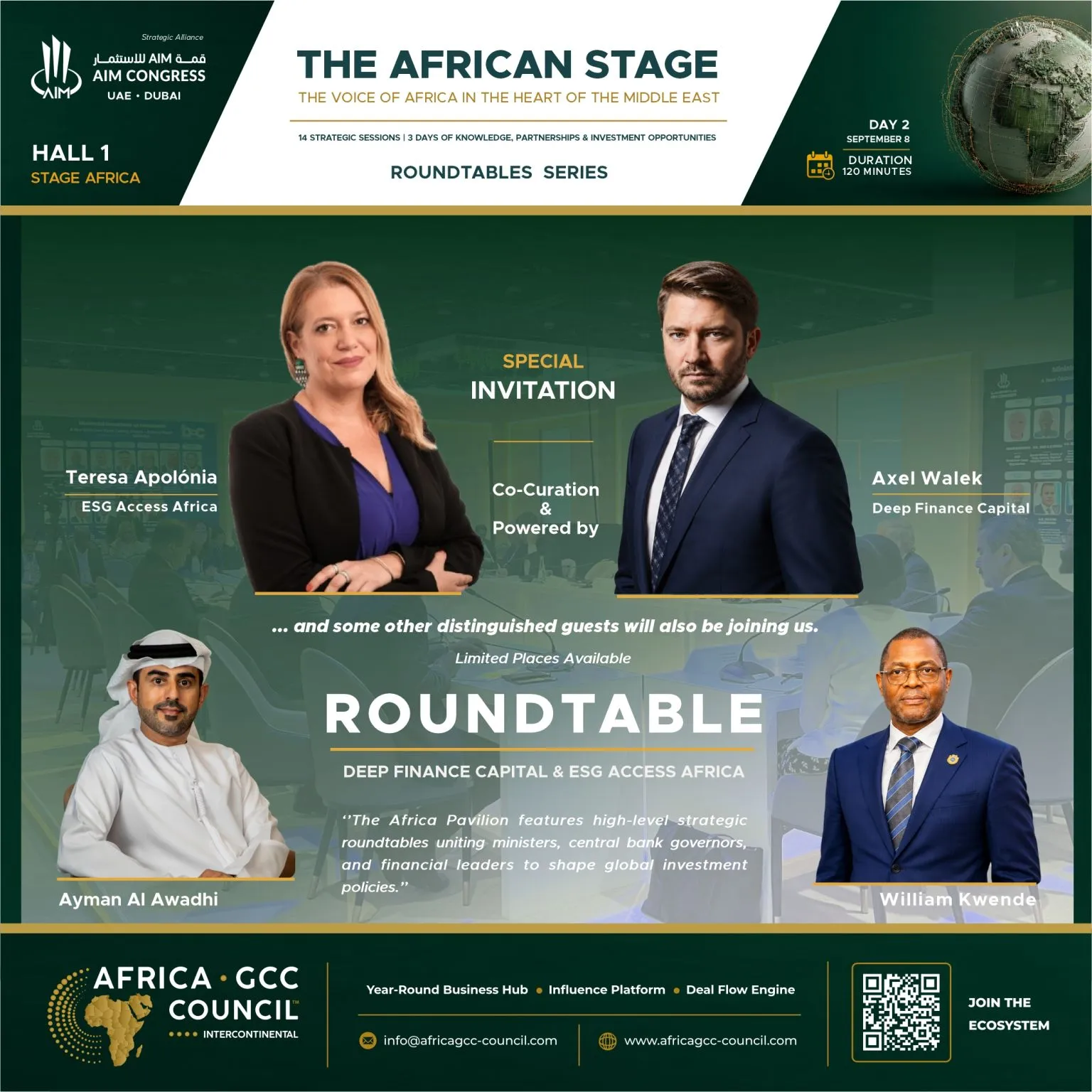
 ESG Access Africa will participate in the Africa Pavilion Roundtable at AIM Congress 2026 in Dubai. Read more (opens in a new tab)
 Born from ESG Access. Built for Africa.
We help public and private organisations understand where they stand, define what matters and turn ESG+E into practical, economically viable action — grounded in local realities and credible to investors, partners and international markets.
The engagement journey
CONNECT • TRANSFORM • GENERATE IMPACT
ESG Access Africa will participate in the Africa Pavilion Roundtable at AIM Congress 2026 in Dubai. Read more (opens in a new tab) 54 countries. Different ESG realities. One direction of travel.
Africa is not one ESG market. Economic structures, environmental priorities, social realities, governance challenges, infrastructure, data availability, investment needs and regulatory starting points all differ — often sharply, sometimes between neighbours.
So the useful question is never which ESG pillar matters most to Africa. It is more specific than that.
What matters most for this country, institution, company, project or investment — and what can realistically be improved from that starting point?
Where the differences sit
- Economies
- Regulation
- Institutional structures
- Natural resources
- Development priorities
- Infrastructure
- Social realities
- Data availability
- Investment needs
- Technical capacity
Africa comprises 54 countries. This describes the diversity of the continent, not the footprint of this firm.
ESG+E.
- E Environmental
- S Social
- G Governance
- E Economic
ESG+E is ESG Access’s practical lens for considering ESG ambition alongside economic viability and long-term economic sustainability.
Environmental, social and governance progress requires economic foundations capable of sustaining it. Investment, competitiveness, employment, infrastructure, access to finance and business viability are not separate from ESG performance — they determine whether it survives contact with the next budget cycle.
Adding the economic dimension is not a way of lowering ambition. It is how ambition gets implemented and stays implemented.
Sustainability should be ambitious enough to create impact, but realistic enough to be implemented and economically sustained.
A practical lens, not a reporting standard, a regulatory framework or an official fourth ESG pillar.
How we work
One journey, five stages. Most organisations enter at Orient or Diagnose and move forward only as far as the work justifies.

ESG Access
Africa
01 / 05
Orient
ESG+E Preliminary Assessment
Build a shared understanding of ESG+E, introduce the practical concepts and tools, consider economic viability, and take a high-level view of what is already in place.
Supporting capabilities ESG Strategy & Advisory · Training & Capacity Building
02 / 05
Diagnose
ESG Strategic Diagnostic
Carry out a structured review of current ESG activity, supporting evidence, gaps, risks, opportunities and readiness.
Supporting capabilities Risk & Compliance · Governance · Specialist assessments
03 / 05
Define
ESG Strategy & Phased Roadmap
Prioritise what is material, urgent and feasible, and build a realistic ESG+E strategy the organisation can actually fund and execute.
Supporting capabilities ESG Strategy & Advisory · Governance · Sustainable Finance
04 / 05
Deliver
Implementation / ESG PMO
Coordinate implementation across internal teams, management, workstreams, suppliers, specialist experts and relevant partners.
Supporting capabilities Stakeholder Engagement · International Value Chains · Governance
05 / 05
Demonstrate
Evidence, Reporting & Investor Communication
Track progress and convert ESG improvements into credible, measurable, decision-useful information.
Supporting capabilities Reporting · Sustainable Finance · Certification coordination
ESG begins before reporting.
Reporting is where ESG becomes visible. It is not where ESG begins, and a firm that starts there tends to produce documents rather than change.
- 01
Mindset
A shared understanding of what ESG means here.
- 02
Strategy
What matters, in what order, at what cost.
- 03
Decision-making
ESG entering the choices that get made.
- 04
Implementation
Work that actually happens.
Standards, due diligence, certifications, monitoring, evidence and reporting are then integrated according to the organisation’s needs — not applied as a starting template.
We build bridges.
Once an organisation understands its own ESG reality, that reality has to become legible to others. Every market states its requirements in its own language; our work is carrying meaning between them without losing what either side actually means.
- Regulation
- Business decisions
- Investor expectations
- Company practice
- Public policy
- Private execution
- Local realities
- International understanding
Read either way. Neither frame is the source.
The bridge carries load both ways.
African organisations need to understand international expectations. International investors and institutions need to understand African realities. The objective is compatibility, not the imposition of one model on another.
Making local performance legible
Organisations whose ESG reality is stronger than their ability to evidence it, facing buyers, lenders and regulators who ask in an unfamiliar vocabulary.
What organisations typically need
- Investor and lender expectations
- International ESG requirements
- Supply-chain requirements
- Financing requirements
- Evidence and documentation
- Market expectations
Understanding the ground
Investors, institutions and companies operating in or entering African markets, where an approach designed elsewhere rarely survives contact with local conditions unchanged.
What organisations typically need
- Country and sector context
- Local ESG realities
- Project realities
- Risks and opportunities
- Implementation constraints
- Stakeholder understanding
Building the overlap
Recognising different starting points is not lowering standards. It is how an implementable pathway gets built between what a market requires and what an organisation can credibly do.
What organisations typically need
- Shared vocabulary
- Realistic sequencing
- Credible ESG information
- Governance readiness
- Prioritisation
- Measurable progress
Three directions of travel. The bridge carries load both ways.
ESG capability becomes a stronger position.
Meeting requirements matters where a market or value chain demands it. But capability built properly pays out more broadly than compliance alone — in governance, in resilience, in how an organisation is assessed by anyone deciding whether to fund it, buy from it or partner with it.
- 01
ESG capability
The organisation can act, not just describe.
- 02
Understanding
What matters here, and why.
- 03
Prioritisation
Sequenced against real constraints.
- 04
Implementation
Work that actually happens.
- 05
Evidence
Performance that can be shown, not asserted.
- 06
Credibility
Assessed well by those who decide.
What this supports
- Stronger organisations
- Better governance
- Investment readiness
- Access to finance
- Organisational resilience
- Credible ESG performance
- Market readiness
- International compatibility
- Stronger decision-making
- Competitive position
Capability improves position. It does not guarantee commercial or financial outcomes.
Not a European model in a suitcase.
We are not arriving with a European ESG model and asking African organisations to conform to it. ESG in Africa must reflect African realities — its industries, cultures and societies, institutions, economies and development priorities — while remaining credible and intelligible to international regulators, investors and business partners.
Africa is not one market. Countries start from genuinely different places: regulatory regimes, industrial structures, institutional capacity and economic conditions differ substantially across the continent, and a strategy that ignores those differences will not survive contact with them.
Our role is not to bring a framework and apply it. It is to begin with the reality of the specific country, organisation, institution, project or investment, and let that context shape priorities and implementation. That is not lowering standards: international expectations remain relevant, and the goal is an implementable pathway toward them rather than a document that asserts one.
The objective is not to impose one model on another. It is to create compatibility between them.
Who we work with.
Different organisations start from different realities. ESG Access Africa adapts strategy and implementation to the institution, market and objective.
01 Companies
Building practical ESG capability — whether strengthening the organisation internally, preparing for investment or responding to value-chain and international market requirements.
- ESG starting-point assessment
- ESG+E strategy
- Governance
- Organisational capability
- Investment and financing readiness
- Value-chain requirements
- Reporting readiness
- Implementation
- International-market readiness where relevant
02 Investors & financial institutions
Understanding ESG risk, governance quality, readiness and local realities when assessing organisations, projects, portfolios and investment opportunities.
- ESG risk
- Governance assessment
- Due diligence support
- Investment readiness
- Portfolio expectations
- Decision-useful ESG information
- Funder requirements
- Local market understanding
- Sustainable-finance considerations
03 Governments & public institutions
Designing locally grounded ESG+E frameworks and implementation pathways that reflect national priorities, institutional capacity and economic realities.
- Country-specific ESG frameworks
- Institutional capacity
- Public governance
- Policy-to-implementation
- Sustainability strategy
- Development priorities
- Economic viability
- Project and investment readiness
- Monitoring and measurable implementation
04 International partners
Helping international organisations understand the ESG realities of the African markets, sectors and projects in which they intend to operate or invest.
- African ESG context
- Local-market understanding
- Cross-border alignment
- ESG risk
- Stakeholder coordination
- Strategy adaptation
- Partnership coordination
- Local implementation support
These describe the organisations we are built to serve. They are not a client list.
ESG built for African realities.
ESG Access Africa brings the international experience, methodology and bridge-building philosophy of ESG Access into a dedicated Africa-focused platform — grounded in local realities rather than importing a model built elsewhere.
Discover ESG Access (opens in a new tab)Parent organisation · founded in Portugal · works internationally
Let's build the bridge.
Whether you're establishing where your organisation stands, preparing for investment, entering a new market or strengthening ESG capability, start the conversation.
CONNECT • TRANSFORM • GENERATE IMPACT